Did my first official 2025 presentation into chickpea agronomy last week. Was good to brush off the cobwebs for our champion pulse crop in chickpeas and the first question I was hit with was about the possible reinstatement of the 60 per cent plus tariff, that had been originally imposed in 2017 by a major import customer of Australia’s.
Of course, we all got a pleasant surprise when it was completely dropped in early May 2024, until the 31 March 2025, prompting a big planting of desi chickpeas in late May, June and even into July for last year.
A total of around 800,000 hectares of desi chickpeas, therefore were mostly planted here in the Queensland and the Northern NSW winter cropping area.
What is it going to be for this 2025 crop, and I am hearing at this stage of a modest tariff imposed of 10 per cent for this year, however be aware this tariff figure has nothing to do with a ruling from Australian growers, our politicians or even old agronomists.
Still an all, we always need a pulse crop in our farming systems here in the North to give us balance and crop rotation from our grass type crops of sorghum and wheat, so broadleaf pulse crops like chickpeas do just that.
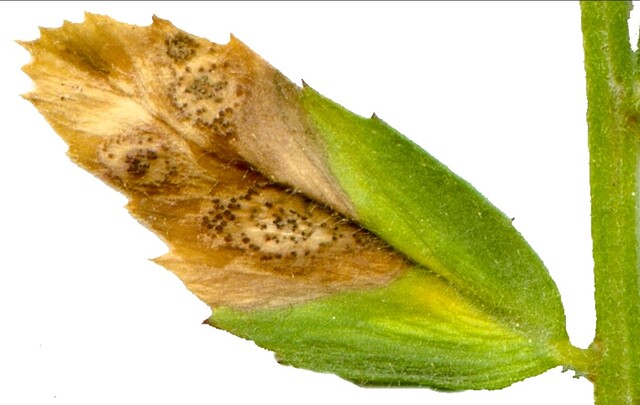
Needless to say, there are couple of bogeymen when growing chickpeas and one of them is a foliar disease like the one pictured here called Ascochyta Blight. This disease first hit us badly in the showery wet winter of 1998 and it spread like wildfire, as fungal spores can in a crop with no specific disease resistance package in its genetics.
It could have been all over for our developing Aussie chickpea cropping industry, except for an exemplary NSW DPI plant pathologist named Dr Kevin Moore, who forged head with developing a fungicide program for this crippling plant disease affecting our Aussie crop.
Kevin showed us the whole range of an Integrated Pest Management system to apply to our future growing prospects of chickpeas.
These are some of his points, that I ran through last week.
Accept that disease elimination is impossible, so economic controls applied on thresholds are best and will differ from crop to crop.
Utilize preventative cultural practices like growing healthy crops, looking after plant and farm hygiene of green bridge volunteers and infected chickpea stubble by destroying them, whilst doing regular monitoring or inspections. No doubt about it, I have seen plenty of volunteer chickpea plants growing in summer with Ascochyta Blight or AB all over them.
Adding in here is the accurate forecasting of any rainfall is especially useful and important for responsible fungicide applications prior to these precipitation events. A rain drop splash on these tiny disease portions of stems or leaves called pycnidia shown in photo, absolutely showers millions or trillions of spores up into the air to land on unprotected leaf or stem surface to start up another downwind colony of diseased plant tissue.
As we saw in 1998, the whole paddock can go black fairly quickly with disease and can be a write off as far as harvesting any good quality grain off it.
A few other key points Dr Moore developed over the decades and that is for another day.